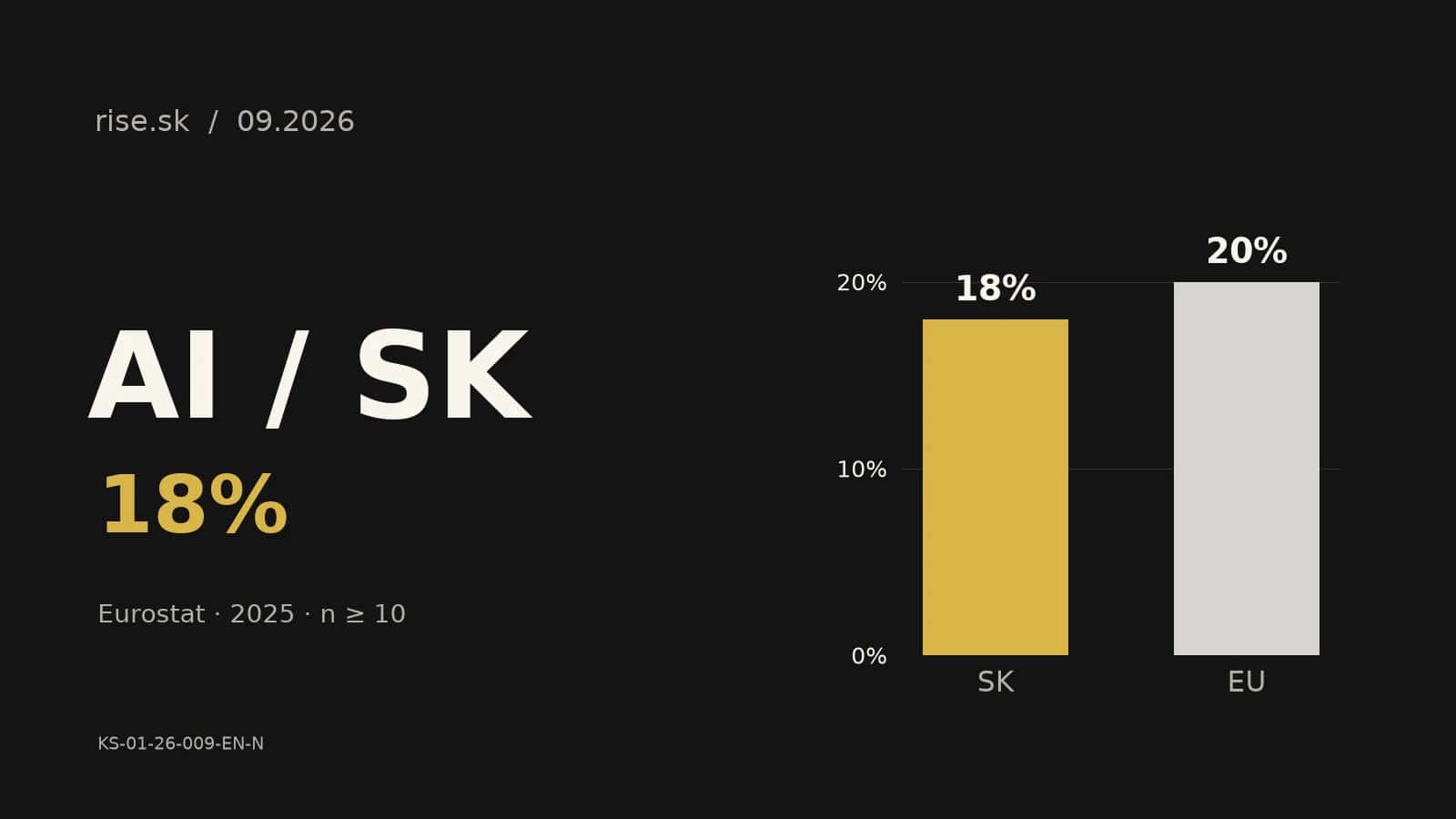
September 2026 AI news and what it means for Slovakia
What September AI releases mean for Slovak businesses and municipalities. Eurostat data, practical scenarios and a modelled calculation of time released.

Slovakia has announced the creation of AI CyberLab, an initiative to bring together academia, state institutions, and the private sector in applying artificial intelligence to cyber defense. It's an ambitious step. But what can AI in cybersecurity actually do, and where are the limits?
AI isn't a magic solution. In a handful of areas, though, it delivers value you can measure.
This is where AI excels. A traditional system runs on rules. If X happens, trigger an alarm. A model instead learns what normal behavior looks like on your network, then flags the deviation a human analyst would have scrolled past. It catches zero-day attacks too, the ones with no signature yet, because it isn't looking for a known fingerprint. It's looking for odd behavior.
UEBA (User and Entity Behavior Analytics) systems work this way when they catch an employee reaching for data at an unusual hour or by an unusual route.
The average SOC (Security Operations Center) receives thousands of alerts a day and most are false positives. AI prioritizes and correlates them by severity and context, which is how it connects events that look unrelated on their own. The analyst stops spending a shift clicking away noise.
AI can place a new sample against known families before a human has opened the file. Static and dynamic sandbox analysis follow, along with a behavior prediction drawn from the code structure. The analyst starts with a hypothesis rather than a blank screen.
There is more threat intelligence published than anyone can read. AI pulls IoCs (Indicators of Compromise) out of reports automatically, correlates threats across sources, and estimates the likely attack vectors.
Not everything sold as "AI-powered security" is as revolutionary as the marketing claims.
No sensible security professional gives AI full autonomy over production systems. AI can suggest, but humans must decide. "Self-driving cybersecurity" is marketing, not reality. Anyone selling you that is either lying or not running production systems.
AI can identify trends and patterns, but it cannot reliably predict specific attacks. Cybersecurity remains a reactive discipline with proactive elements, not the other way around.
AI won't replace security analysts. It changes the job. Less manual triage, more strategic decision-making. But human judgment, creativity, and the ability to understand context can't be automated.
Set up properly, the initiative could do several things at once.
A central platform where organizations securely exchange threat information. AI processes and correlates data from various sources.
University-industry collaboration on AI security applications. Slovakia has a strong tradition in computer science, it needs to use it.
Beyond that, the initiative can deliver an AI-powered cyber range for training security teams (simulated attacks that adapt to defense) and connect security professionals across sectors.
An anomaly-detection pilot should use a labelled log sample, agreed metrics, and human confirmation of findings. Measure detected incidents, false positives, analyst time, and whether each alert can be explained after the fact. Without that evidence, a benefit claim is not verifiable.
AI in cybersecurity isn't the future, it's the present. But it's not a silver bullet and probably never will be. It delivers the most value in the hands of people who know what they're doing. AI CyberLab has potential to move Slovakia forward, if it focuses on real results. Leave the buzzwords to marketing.
Want to integrate AI into your company's security processes? Let's talk about what makes sense for your situation.

Founder and CEO of Rise.sk. He designs and delivers web applications, data systems, and automation, and writes about software decisions, AI, and digital services.
What September AI releases mean for Slovak businesses and municipalities. Eurostat data, practical scenarios and a modelled calculation of time released.

Chinese models are now months, not years, behind the US frontier, at a fraction of the cost. For a European firm the real question is not who wins the race, but whether and how to use them.
Google's new Private AI Compute aims to solve the enterprise dilemma. How do you use powerful cloud AI without compromising sensitive data?