You bought low-code because code was expensive. That price moved
Much of the low-code and boxed-system decision making rests on one number, the cost of a developer day. That number changed and almost nobody recalculated.

Written for whoever signs the estimate

The questions worth answering before the scope is signed. We got most of them wrong once, which is why they are here.
Much of the low-code and boxed-system decision making rests on one number, the cost of a developer day. That number changed and almost nobody recalculated.
Meta opened its display glasses to plain HTML. You cannot buy them in the EU. The interesting part is what it says about the system you are commissioning this year.
iPadOS 27 landed on 14 September and app windows now go to any width a person drags them to. Your CSS asks how big the screen is when it needs a different answer.
Apple announced the iPhone Duo. A foldable does not break your site by folding. It breaks it by changing the window width mid-session. What to test, and at which widths.
Shopify rebuilt the Shop app from React Native into Swift and Kotlin in twelve weeks. The decision was about what code costs now, not about performance.

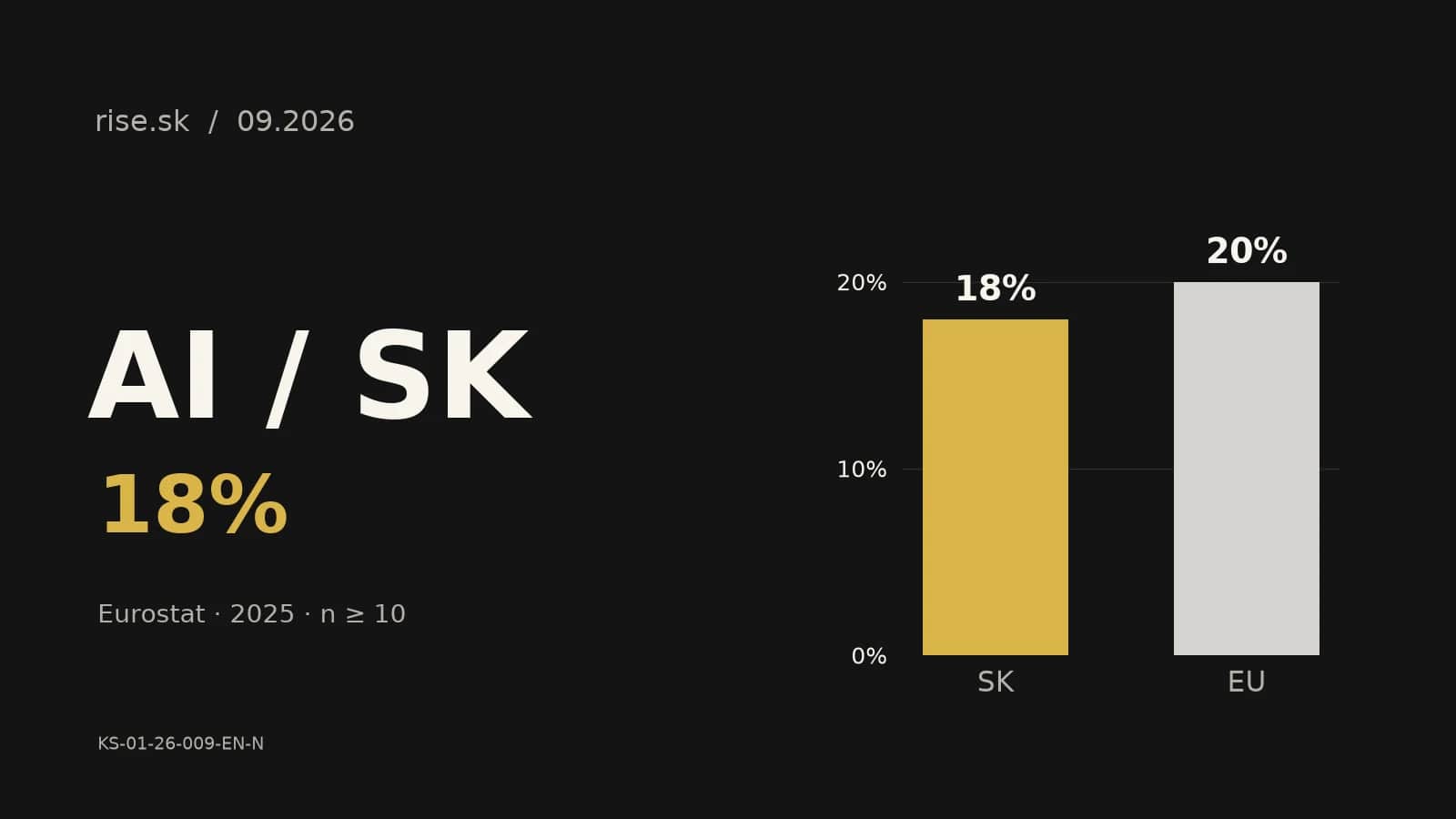
What September AI releases mean for Slovak businesses and municipalities. Eurostat data, practical scenarios and a modelled calculation of time released.
Three paragraphs produced 55,000 lines of game code and a score of 5.05 out of 10. The method behind it works on business deliverables too, and the honest numbers are the useful part.
Five beats. Every article sits in exactly one of them.
Before investing in software
Practical guides for comparing your options and deciding what to do next.
Risk, cost and impact on day-to-day operations.
Value, data readiness and the risk of a first pilot.
Evidence and terms of working together.
Total cost and a realistic return.
Data, access, integrations and changing supplier.
July 2026 brought the steepest AI price cuts on record, and 73 percent of companies still overshot their AI budget. The number that decides the bill is not the price of a token but how many tokens one finished task burns.

A practical account of semantics, keyboard use, focus, contrast, forms, reflow, reduced motion, and the limits of automated accessibility testing at Rise.sk.

Compare Next.js with Axum, Askama, and htmx through browser state, contracts, caching, deployment, security, mobile clients, and project handover.

Replace risky parts of an older system in controlled stages. Learn how seams, a facade, contract tests, parallel runs, and rollback turn modernization into managed delivery.
We sell what we write about. Each line has one person answerable for it.
Everything we have published so far, filtered by topic or by month.

A practical operating model for software teams that want AI agents to implement changes while people retain approval, review, merge, and deployment.

Choose a first automation by scoring the work, data, risk, ownership, and reversibility. Then validate one pilot before you expand it.

A buyer checklist for security, integrations, data roles, ownership, support, and exit planning before signing a software contract.

Build a software or automation business case from measured current-process cost, TCO, scenarios, sensitivity analysis, and explicit stop criteria.
Chinese models are now months, not years, behind the US frontier, at a fraction of the cost. For a European firm the real question is not who wins the race, but whether and how to use them.
OpenAI says GPT-5.6 Sol beats Claude Fable 5 on coding at a third of the cost. Anthropic says Fable 5 leads on raw capability. Both are right. Here is which model wins which job.