
Top 10 Workflows Where AI Actually Saves You Time
Ten model workflows for an AI pilot, including what to measure before deciding whether they save time.
Every new AI model prompts the same question. Is it better? For a company director or the head of a public office, the useful question is more concrete. Can their team complete the same work reliably, faster and with a result they can trace?
Early September brought OpenAI's GPT-6 Astra and Anthropic's Claude Fable 5.1. Both vendors describe improvements in longer work tasks. For Slovak organisations, that is a reason to examine one specific process. An announcement of a new model alone is not a reason to replace an entire information system.
Information is current as of 12 September 2026. The examples below are illustrative proposals. They are neither Rise implementations nor measured Rise results. Public statistics are kept separate from our calculations, and product updates reflect the vendors' announcements.
OpenAI introduced Astra on 3 September. Its announcement covers computer use plus document and spreadsheet creation in multi-step tasks. The rollout began with a limited group of organisations, with broader availability planned afterwards. Check directly what is available in a particular account, including the tools it permits.
The change that matters is joining steps together. A business enquiry needs more than a polite email. It may require comparing an attachment with a catalogue, finding missing information and preparing material for the sales representative. Test that whole sequence. An overseas benchmark does not show that a model will correctly read your price list or understand a Slovak abbreviation in an order.
Anthropic says Fable 5.1 is generally available, while Mythos 5.1 remains under limited access. For Fable, it announced a changed price for reading cached, reused inputs. A lower price-list item does not by itself determine the cost of a completed request.
Reusing input can help with a long document. If an employee must correct every other answer, however, the model bill is only a smaller part of the problem. Compare the whole procedure, including data preparation and checking. Keep the same test set when choosing a provider so one successful demonstration does not decide the outcome.
Anthropic also announced the planned Enterprise Frontier Safeguards system, with gradual availability in autumn. Do not assume it is active for every account. Before uploading internal documents, verify the actual terms for retaining and accessing data.
A third update points to the other side of the same capabilities. Anthropic's September report on AI misuse describes selected detected cases from December 2025 to August 2026. It is not a statistic on the frequency of attacks in Slovakia, nor evidence that the newly released Fable 5.1 has been misused.
That leads to a simple operating rule. An assistant that prepares a reply does not also need permission to send mail, change a supplier's bank account and delete attachments. Give permissions according to the task. Connecting another application is a separate decision, and responsibility for the action must be clear.
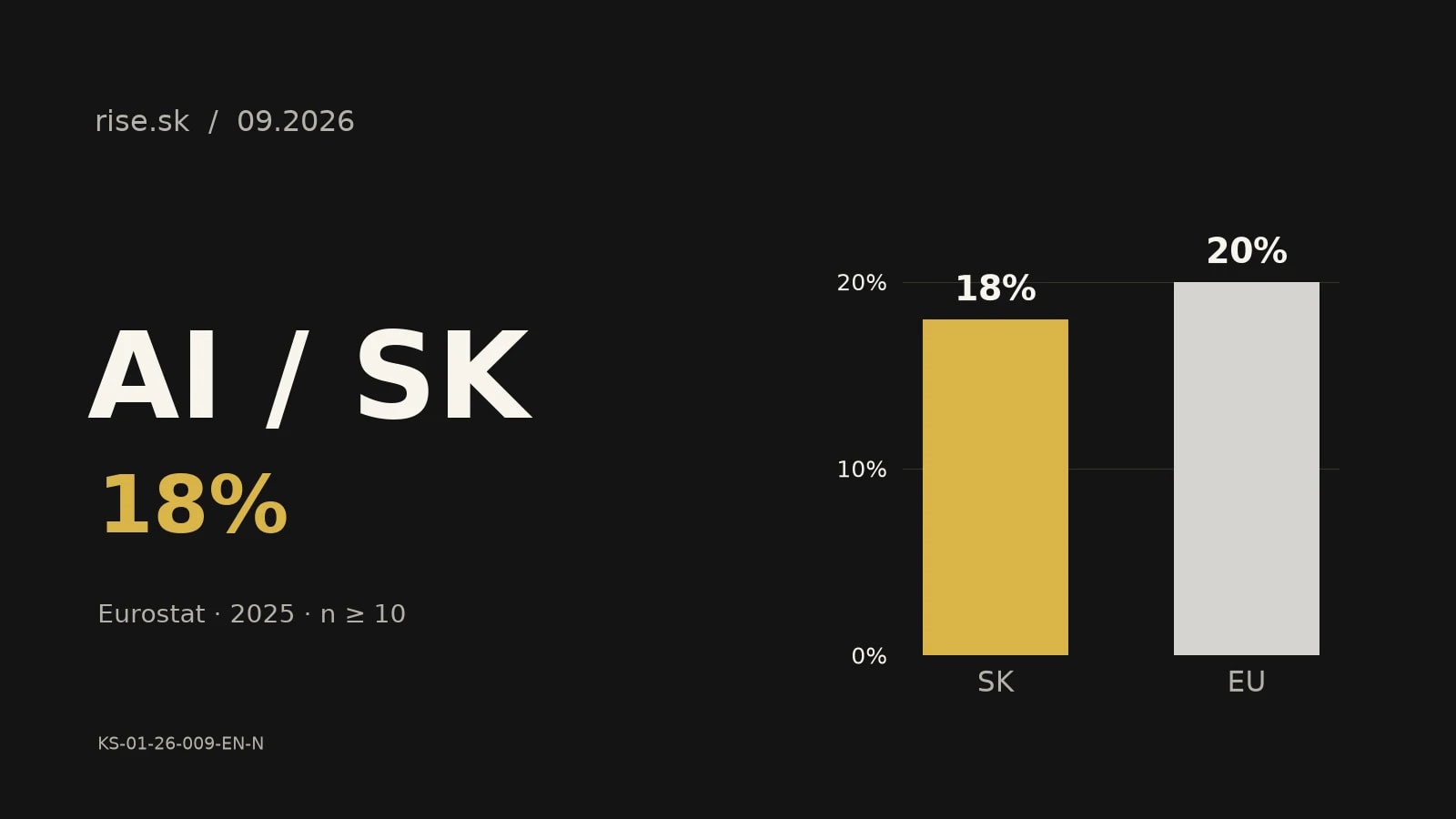
Eurostat's Table 1 on AI use reports that 18% of Slovak enterprises used at least one tracked AI technology in 2025. The EU average was 20%. The share was 15.6% for small Slovak enterprises and 43.7% for large ones.
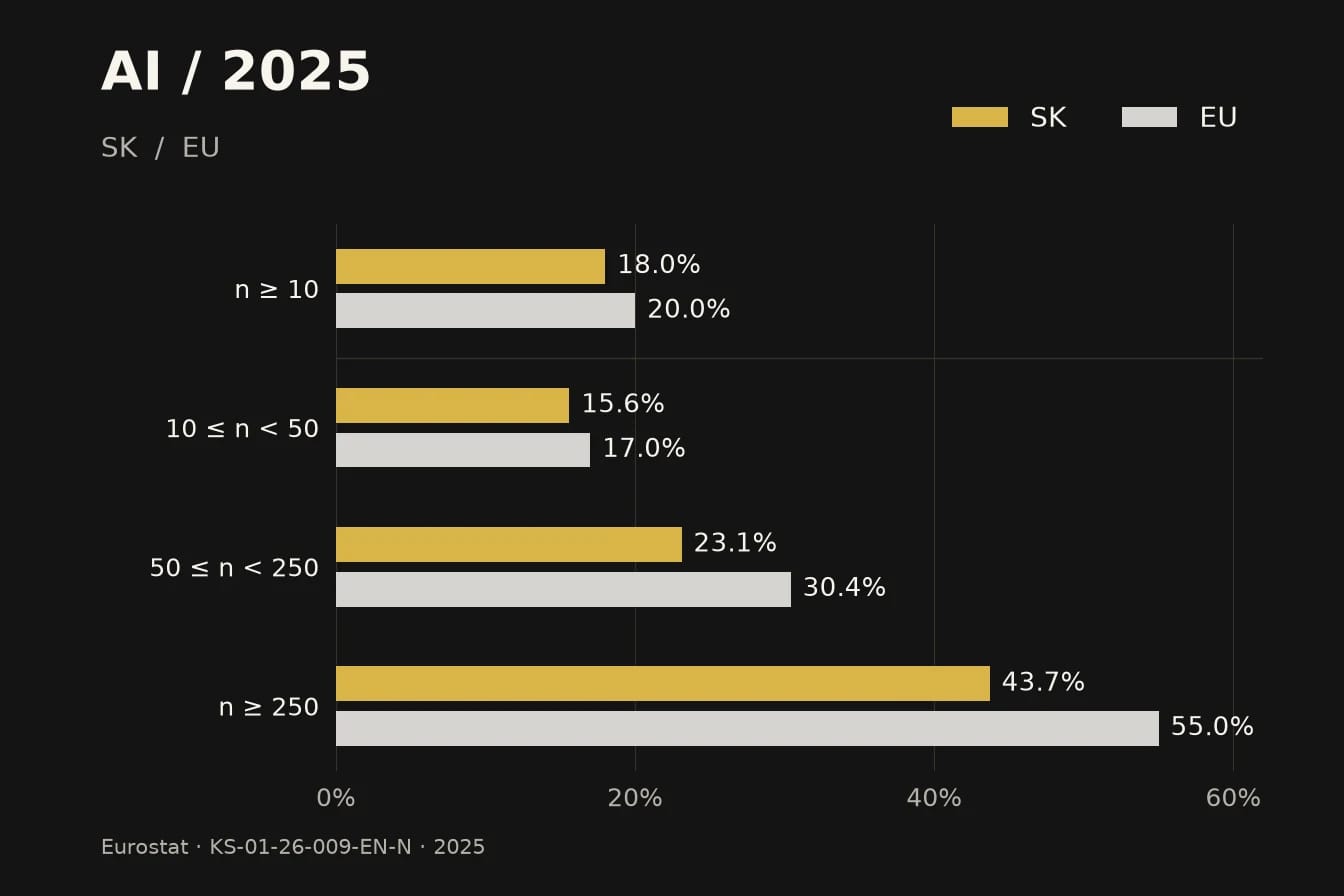
Gold represents Slovakia, grey the EU. The letter n is the number of employed persons. The gap between small and large Slovak enterprises is 28.1 percentage points.
Original chart using Eurostat data, Table 1On a smaller screen, scroll the table horizontally.
| Enterprise size by number of persons employed | Slovakia | EU |
|---|---|---|
| Total, at least 10 | 18.0% | 20.0% |
| Small, 10 to 49 | 15.6% | 17.0% |
| Medium, 50 to 249 | 23.1% | 30.4% |
| Large, 250 or more | 43.7% | 55.0% |
The figures come from a 2025 survey of selected business sectors. Public administration and enterprises with fewer than ten persons employed are excluded. The survey tracks several AI technologies, not only generative chatbots. It cannot tell us how many Slovak municipalities use AI or how many companies subscribe to a particular model.
The gap between large and small enterprises in Slovakia is 28.1 percentage points. That is our subtraction of published values, not a separate Eurostat indicator. The gap between Slovakia and the EU average for all tracked enterprises is two points.
Both views matter for a decision. Closeness to the European average does not give smaller organisations the same opportunities as large ones. Nor can this table identify the cause of the gap or the success of deployments. A high rate of use says nothing about return on investment. An unsuccessful experiment still counts as AI use.
A smaller company or municipality needs an accessible starting point. That means one understandable process, someone who knows it and data that support an honest comparison of the old and new procedure. A licence cannot replace that foundation.
Take a technical equipment supplier as an illustrative example. A customer emails an attachment and an incomplete product designation. The sales representative currently searches the catalogue, establishes the parameters and asks for missing information. AI could prepare a working reply draft with links to specific items.
The input must include a valid catalogue with a version date and a list of information to obtain from the customer. The draft should take price and stock availability from the designated system. Without them, it should mark them as unknown. An estimated delivery time in a polished email can create more work than manual handling.
The sales representative checks the match with the enquiry and sends the reply. In the first pilot, the assistant must not send a binding offer itself. Measure the time to reach a sendable reply, the number of factual corrections and whether missed information requires contacting the customer again.
AI can make sense for reading inconsistent attachments. Moving fields already completed in a form into a CRM may need only a standard integration. We also explain the distinction in our guide on when to use an AI agent and when to use automation.
A resident asks how to register a waste bin after moving home. This is an illustrative situation, not a description of a particular municipality. The assistant should find the current procedure, relevant form and contact for the responsible office. Its benefit lies in a usable answer that spares the resident from having to establish the same matter repeatedly.
First put the sources in order. The municipality identifies valid documents, their effective dates and the owner responsible for updates. An old price list in a forgotten PDF must be distinguished from the current regulation. The employee needs to see the paragraph or page behind the draft. A link to the municipality website's home page is not enough.
Start with an internal assistant for an employee working with public documents. Consider a direct resident interface only after accuracy is verified. Where sources conflict or a question needs a personal assessment, the system should hand the case to an employee. An informational draft is not a decision on entitlement, a fee or a penalty.
Track the result for the resident as well. Is the form valid? Does the link reach the correct office? Was further contact needed because the answer was incomplete? These questions say more about quality than the number of assistant conversations. Keep telephone and in-person contact for people who will not use the digital service.
In an illustrative state organisation, an employee compares two versions of an internal procedure. AI could mark changed paragraphs and list places for the responsible subject-matter owner to assess. With many documents, simply finding the source may also have value.
Every document needs a version number, effective date and permissions. An employee must not obtain through the assistant information unavailable by the normal route. A citation must lead to the actual document and relevant location. If a required source is missing, it is also correct to state that the available sources cannot answer the question.
The subject-matter owner confirms the interpretation and any change to the procedure. Do not give the model independent authority to decide a person's rights. A pilot should check whether the employee finds correct, valid information faster and how many proposed differences are wrong. Deliberately test withdrawn documents and questions beyond the available sources.
For simply marking textual differences between two files, start with an ordinary document comparison. Add AI where context between paragraphs or meaning-based search is needed. It must still be possible to establish how the result was produced.
When selecting a provider, ask for a demonstration using your own approved document. Check whether it flags a missing source and respects the different permissions of two employees. A polished presentation with a prepared question proves neither. Also agree who corrects the source document when the procedure changes and who checks the assistant after a model update.
For a municipality with a small team, maintaining its own knowledge base can be harder than launching the assistant. A shared technical platform for several municipalities is possible, but each municipality's content must stay separate. An answer based on a neighbouring municipality's generally binding regulation is wrong even if it sounds convincing. Give equal attention to separating non-public data. A shared provider does not mean shared access permissions.
Assume 300 requests a month. The original procedure averages 12 minutes per request. The new one, including draft reading, source verification and corrections, averages 5 minutes. The calculation is 300 × (12 − 5) / 60 = 35 hours.
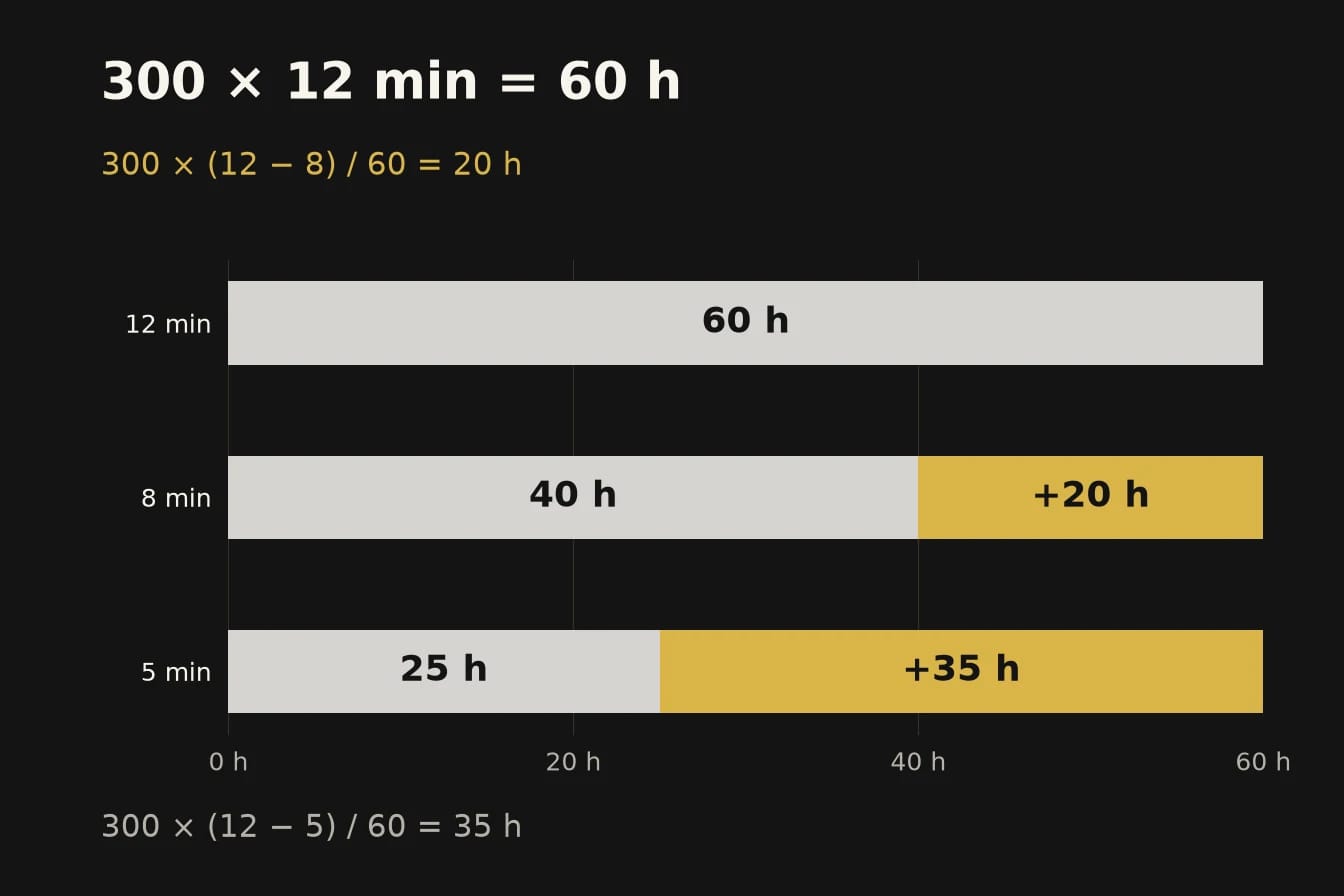
Grey shows working time, gold released capacity. This is our hypothetical calculation including review and corrections, not measured savings.
On a smaller screen, scroll the table horizontally.
| Model scenario | Average per request including review | Work for 300 requests | Capacity released |
|---|---|---|---|
| Original procedure | 12 min | 60 h | 0 h |
| New procedure, slower version | 8 min | 40 h | 20 h |
| New procedure, faster version | 5 min | 25 h | 35 h |
All table inputs are chosen assumptions. This is neither a survey nor our customer result. The averages must include cases where AI did not help and an employee finished them manually. Counting only successful drafts in the new time artificially improves the result.
Thirty-five released hours are not an automatic payroll saving. They may allow a backlog of submissions to be handled or complex cases to receive closer review. The organisation needs to know how it will use that capacity. Financial evaluation also includes licences, integration, training and ongoing source maintenance.
At the same workload, every extra minute means five hours a month. Review therefore deserves the same careful measurement as response generation. If the new procedure averages more than the original 12 minutes, its time benefit is negative, even if the first draft arrives almost immediately.
Choose one recurring process and its owner. For an initial test, prepare, for example, 50 historical cases you are permitted to use. This is a proposed test size, not a statistical guarantee. Do not select only clean attachments and simple questions. Include missing data, old documents and cases that should go to a person.
Record the expected outcome first, then measure the original procedure. Configure the assistant with part of the cases and reserve the rest for final verification. A person who has already solved a case may remember the answer, so account for that in the comparison. Vary the order. Faster performance on a second attempt alone is not an AI effect.
Before the test, define acceptable quality and the error that stops the pilot. In a municipal information service, that could be an invented fee or a link to an invalid form. Results are evaluated by a person who knows the process. The model's self-assessment cannot replace verification.
At the end, show the time for a correctly completed request, factual errors and the share of cases handed to a person. Add the full test cost and an outage test. If the service fails, the employee must know how to continue with the original procedure. When designing access, use our checklist for connecting an AI agent to company systems.
September's models are a good reason to run this test. Expand use only afterwards. In Slovakia, a procedure that saves a resident a repeat office visit or removes a recurring company error will be more valuable than another subscription with no clear use. When designing AI automation, start with a process you can demonstrate, measure and take back over if a problem occurs.
AI supported the research, writing and translations. Public sources appear beside the claims they support. Examples and time calculations are hypothetical, not Rise customer results.

Founder and CEO of Rise.sk. He designs and delivers web applications, data systems, and automation, and writes about software decisions, AI, and digital services.
Ten model workflows for an AI pilot, including what to measure before deciding whether they save time.

Companies either ignore AI or try to change everything at once. Both are wrong. Here's a realistic 30-day plan.

July 2026 brought the steepest AI price cuts on record, and 73 percent of companies still overshot their AI budget. The number that decides the bill is not the price of a token but how many tokens one finished task burns.