



Modular Monolith vs Microservices: A Decision Guide
Microservices buy independent change at a real operating cost. Compare both models through boundaries, ownership, data, deployment, and signals that justify extraction.
Pohoda, Money S3 and KROS connect through three different routes. What each allows, how KROS guards against duplicate documents and what to test before go-live.
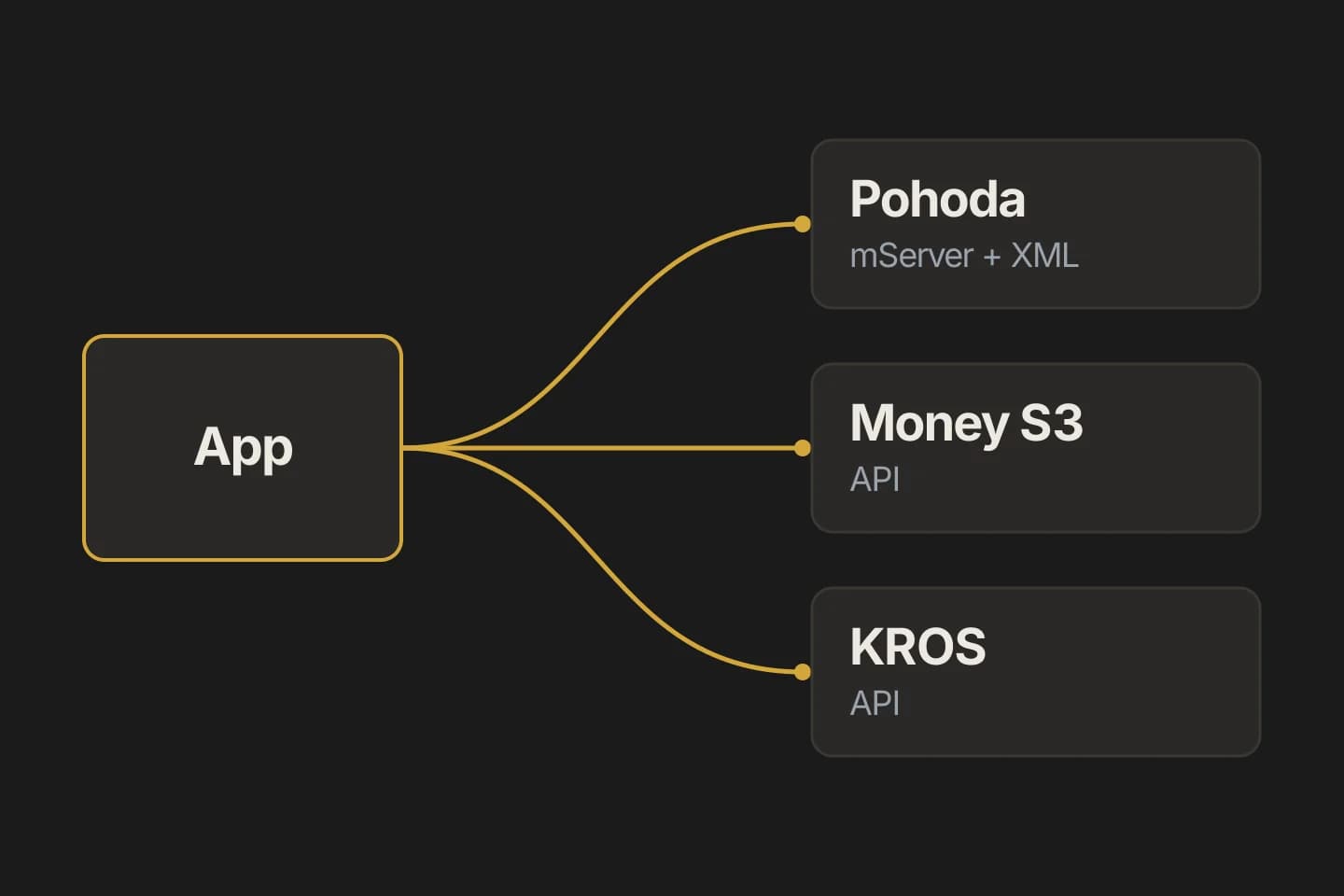
An order is created in your application and the accountant still retypes the invoice into Pohoda by hand. An integration can remove that step, but Pohoda, Money S3 and KROS connect through three different routes and each has its own traps.
Before any code, decide for each kind of data which system owns it. Agencia.sk (28 September 2026) suggests this split. The CRM owns contacts and customers, the CRM or an information system owns orders and jobs, and accounting owns invoices and credit notes. Payments and balances always belong to accounting and the CRM only displays them.
The reason is practical. Modulario (18 February 2026) lists two-way synchronisation without a designated source of truth as the first mistake. In our view, if an invoice is edited in both systems, conflicts are only a matter of time.
Pohoda can be connected through mServer. According to STORMWARE it is a server that receives HTTP requests and passes them to the accounting program. Data travels only as XML, and XML can be sent only with the POST method. Each request needs an STW-Authorization header with a user name and password encoded in Base64, and only Basic Authentication is supported.
The vendor describes mServer as a way to communicate on a local network or on a single computer. Every instance has its own port, and HTTPS can be switched on in its settings. From this we conclude that if Pohoda runs in the office and your application runs in the cloud, network access has to be solved, for example with a VPN or a small relay service inside the company network, and mServer should not be exposed directly to the internet.
We did not find the mServer licence terms or the XML schemas in primary sources. Check them with STORMWARE before the supplier sends a quote.
Money introduced an API for Money S3 in 2024 as a beta available from version 24.250, according to an article of 29 February 2024. The article mentions the S3 API module and the option to use an integrator. We could not establish the current status of the API or the licence terms it is offered under, so those need to be confirmed with the vendor.
We have a concrete price only for the ready-made add-on that connects an online shop. Eshop-rýchle costs €18.80 a month without VAT and requires the API module. Prices and terms change, so check them before you decide.
KROS publishes documentation for integrators, but the API covers only the products KROS Fakturácia and KROS Sklad. OMEGA, ALFA plus, OLYMP, ONIX and CENKROS 4 are not in it. If you use one of those, start with that question.
Through the API you can write issued invoices, credit notes, advance invoices, orders and delivery notes and read them back. Payments are sent with a variable symbol and KROS pairs them with the document. Received documents and expenses are read-only. Editing a finished invoice through the API is not supported. It can only be replaced by sending it again with the same number and series. Access is based on user consent. According to KROS the integrator redirects the user to a KROS page, the user grants consent and KROS issues a token for each approved company.
Plan for the limits as well. The documentation states 10 requests per second and 300 per minute per token. A bulk transfer of old documents has to be scheduled around that.
In our view, one of the most damaging integration mistakes is a document created twice. KROS handles it as follows in its documentation. A 202 response does not mean success, only that the request was accepted, and the result arrives through a webhook. A document sent again with the same number and series is overwritten, so no duplicate appears. A document without a number always creates a new one.
Some calls behave the other way round. Stock movements and delivery notes through POST /api/delivery-notes/single return 201 and every call creates another document. Sending an invoice through POST /api/invoices/{id}/send has no idempotency key, so every successful call emails the customer again. KROS also rejects an identical request with a 409 if you repeat it within 120 seconds of the successful one. Our rule is simple. After a timeout, check the status first and retry only then.
For Pohoda and Money S3 we found no such duplicate protection in the available documentation. Do not assume it. Keep a record in your own application of which document you already sent and under which number, and ask the accounting program before you retry.
Modulario names four further mistakes. The first is ignoring VAT context. The second is missing payment matching, in our reading, a situation where a payment is recorded in accounting but the ERP does not know about it. The third is ignoring closing periods, in practice for example posting a document into an already closed period. The fourth is testing only the standard flow, without corrections, credit notes and overpayments.
Before launch, test at least a credit note, a payment one cent above the invoice and a document dated in a closed month. The accountant, not the integration, still decides whether cash flow and the books are correct.
In our view a ready-made add-on such as Eshop-rýchle is often reasonable for an ordinary online shop. A custom integration pays off when documents come out of your own process, for example orders, jobs or approvals, and a ready-made connector does not know it. We cover the cost in the article on how much custom software costs.
Integration is often a cheaper route than replacing the whole system, as the article on modernisation without a rewrite shows. What to check with an integration supplier is summed up in the checklist on security and software ownership. If you want the integration designed, we can help with custom software development.
Prepared with AI assistance from vendor documentation and trade articles. We did not test the interfaces in practice and licence terms change, so check them with the vendor.

Founder and CEO of Rise.sk. He designs and delivers web applications, data systems, and automation, and writes about software decisions, AI, and digital services.
Microservices buy independent change at a real operating cost. Compare both models through boundaries, ownership, data, deployment, and signals that justify extraction.

Compare Next.js with Axum, Askama, and htmx through browser state, contracts, caching, deployment, security, mobile clients, and project handover.

Three paragraphs produced 55,000 lines of game code and a score of 5.05 out of 10. The method behind it works on business deliverables too, and the honest numbers are the useful part.