



Software vendor due diligence for security and ownership
A buyer checklist for security, integrations, data roles, ownership, support, and exit planning before signing a software contract.
Three quotes for the same system rarely agree because each assumes a different scope. What published estimates and rates say, and what really moves the price.
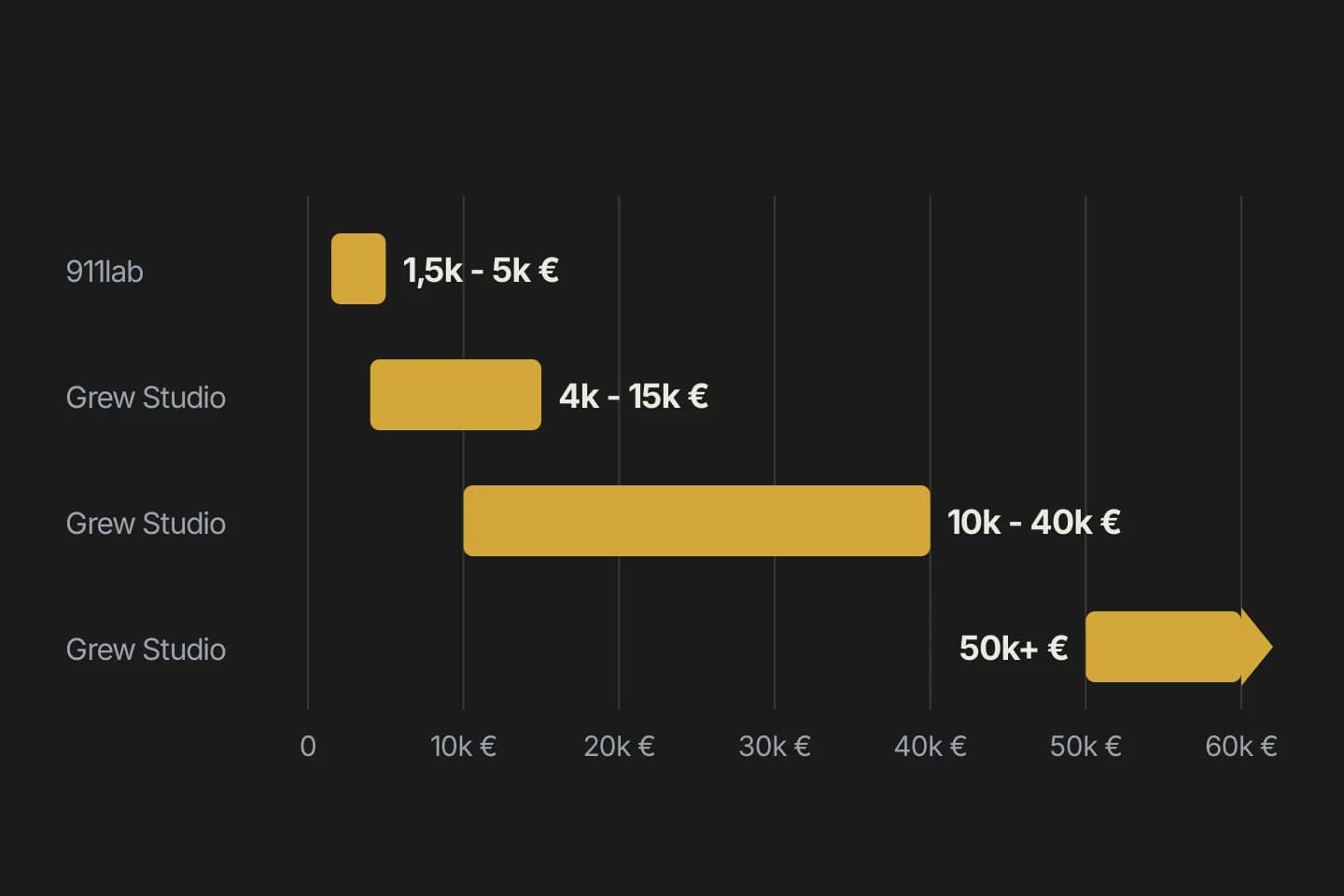
Three quotes arrive for the same company system and no two of them agree. The cause is rarely the quality of the teams. Each quote quietly assumes a different scope behind the word "system".
Slovak suppliers publish ranges on their blogs, not fixed prices. Two sources we opened on 27 November 2026 look like this.
On a smaller screen, scroll the table horizontally.
| Scope | Published estimate | Source |
|---|---|---|
| Simple application or module | on the order of €1,500 to €5,000 | 911lab, 5 August 2026 |
| Simple web application or MVP | €4,000 to €15,000 | Grew Studio, 15 October 2026 |
| Mid-size company system | €10,000 to €40,000 | Grew Studio, 15 October 2026 |
| Large platform | from €50,000 | Grew Studio, 15 October 2026 |
Treat the figures as a rough guide. They are estimates from suppliers who sell software, not an average of completed projects. Grew Studio states prices without VAT unless noted otherwise and adds 23 % for VAT payers. We could not find whether 911lab includes VAT. The standard Slovak VAT rate has been 23 % since 1 January 2025. When you compare quotes, convert everything to the same basis, with or without VAT.
Notice also that the ranges overlap. A "simple application" ends at €5,000 in one source and starts at €4,000 in the other. The name of a scope does not define its price.
Grew Studio reports that a programmer's hourly rate in Slovak quotes runs from €30 to €85. For comparison, the IT rates analysis by the Slovak ministry MIRRI gives a programmer €473 per person-day in the lower quartile, €560 at the median and €640 in the upper quartile. These are prices without VAT from state contracts concluded between 2023 and 16 June 2026, so they do not describe the private market. On an eight-hour day the median works out to about €70 an hour. That is our own conversion.
Our development rate is €45/h + VAT, published on our pricing page. The number of hours matters more than the rate, though. A cheaper hour does not help if the quote covers half the work the system actually needs.
According to 911lab, the price is set by scope, integrations, the number of users and roles, and the data that has to be moved. We add where we think budgets most often drift.
Scope means the number of processes the system covers. Limit the first version to one process and leave the rest as later stages. That way you compare work, not promises.
Integrations are connections to invoicing, stock, an online shop or payments. Each one has an external interface you do not control and that can change. We cover how this looks for Slovak accounting software in the article on connecting an app to Pohoda, Money S3 and KROS.
Users and roles add to the price quietly. Every role needs its own screens, permission rules and tests. A system with two roles is not half the price of one with four, but in our experience the difference is usually noticeable.
Data means migration from spreadsheets, paper or an old system. The transfer itself is often quick. Cleaning and unifying records usually takes longer, so look for it as a separate line in the quote.
A system can go live, but it cannot be left alone. Grew Studio puts maintenance at 15 to 25 % of the development price per year, plus the cost of servers and third-party services. For an example system priced at €20,000 without VAT that would be €3,000 to €5,000 a year. With VAT the development alone comes to €24,600. Both numbers are our own calculation.
Ask the supplier what maintenance includes. Bug fixes, library updates and backups are different work from new features, and it pays to keep them apart.
A good quote names what is in the first version and what is not. It states the number of roles, the list of connections, the way data is migrated and who owns the source code after handover. If any of that is missing, ask about it. It is not a saving.
A fixed price makes sense when the scope is agreed in writing. With a vague brief it is often just shifted risk that returns as extra payments for changes. When the scope is unclear, working in stages with a separate price for each is fairer.
Before you contact suppliers, write one page with the processes, roles, connections, data and the boundary of the first version. You will get comparable quotes and see faster where opinions differ. If you then want to know whether the investment pays back, the business case guide helps. Our custom software development service can help with scoping too.
Prepared with AI assistance. The amounts are estimates from the blogs of suppliers, not an average of completed projects. State rates come from state contracts. Check them before you decide.

Founder and CEO of Rise.sk. He designs and delivers web applications, data systems, and automation, and writes about software decisions, AI, and digital services.
A buyer checklist for security, integrations, data roles, ownership, support, and exit planning before signing a software contract.

A practical guide to defining requirements, comparing suppliers, validating delivery evidence, and reaching a defensible technology-partner decision.

A financial customer needs evidence that its ICT service is managed. What to agree in the contract and how to test recovery and incident communication.