Skip to content

Automated Document Processing: How We Build AI That Reads, Links, and Fills Documents for You

Stacks of documents and papers representing document processing automation

Every company that works with documents — and that's practically every company — knows the feeling. Invoices, contracts, reports, submissions, internal summaries. Someone has to read them, find the relevant data, enter it into a system, check for consistency, and ultimately create yet another document from all of it. Manually. Over and over again.

According to McKinsey research, knowledge workers spend up to 19% of their working time searching for and gathering information. In practice, this means an accountant, lawyer, or compliance officer spends one day out of the workweek doing something a machine could handle. And that doesn't count the time spent correcting errors that arise from manual data entry.

At rise.sk, we decided to tackle this problem systematically. We're building a platform for automated document processing — a solution that doesn't just read documents but understands them, links information across them, and generates outputs without human intervention.

What Exactly We're Solving

Our solution covers the entire document lifecycle within a company:

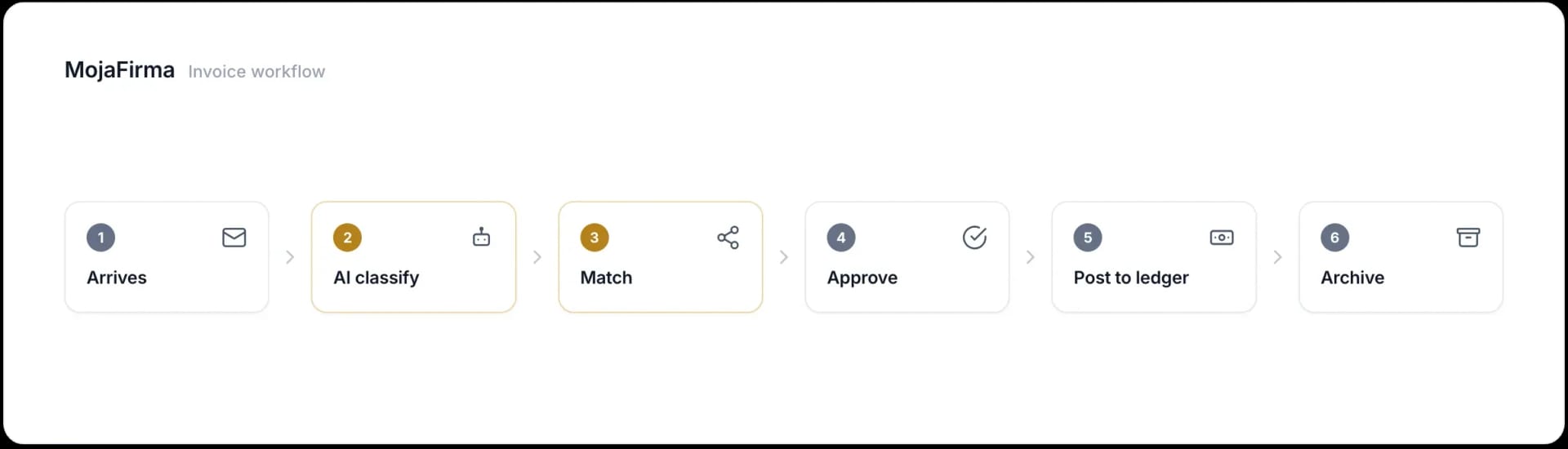
  1. Document intake — PDF, scan, email attachment, Word, Excel. Documents arrive in any format.
  2. Analysis and extraction — AI reads the document, identifies its type, and extracts key data (amounts, dates, parties, company IDs, contract numbers).
  3. Entity linking — The system automatically links extracted data with existing records: company ↔ contract ↔ invoice ↔ contact person.
  4. Output generation — Based on extracted and linked data, the system fills template documents, generates reports, or creates summaries.

This isn't a chatbot that answers questions about a document. It's a pipeline that processes hundreds of documents daily without anyone having to look at each one individually.

Three Core Platform Features

1. Automatic Document Analysis

The first step is understanding. When a document enters the system, the AI model first classifies it — is it an invoice, contract, delivery note, or internal report? Each document type has a different structure and different relevant data.

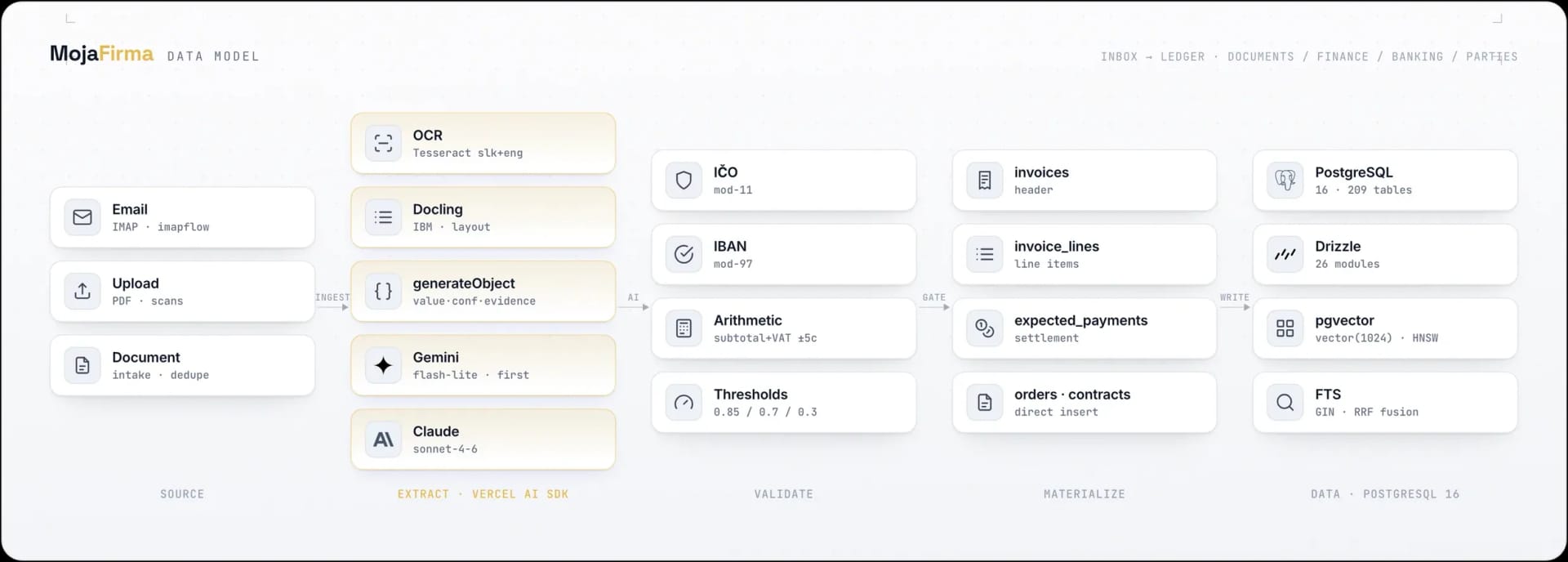
Then extraction kicks in. A combination of OCR (Optical Character Recognition) for scanned documents and NLP (Natural Language Processing) for digital texts allows the system to pull exactly the information you need. For invoices, that means amounts, due dates, supplier and buyer IDs, order numbers. For contracts, it's the contracting parties, subject matter, performance deadlines, and penalties.

The key point is that the system doesn't learn from rigid templates. We use language models that understand context. If a supplier changes their invoice layout, the system still finds the correct data because it understands what "due date" or "total amount" means — not where exactly on the page it's located.

2. Intelligent Entity Linking

This is the feature that transforms simple extraction into a truly valuable platform. When the system extracts data from a document, it automatically links it with existing entities in the database.

Example: An invoice arrives from company ABC Ltd. The system recognizes the company ID, finds the existing record in the database, links the invoice to the active framework agreement, identifies the contact person, and assigns the invoice to the correct project. All without a single click.

Linking works in the other direction too. When you open a client card, you see a complete overview: all contracts, invoices, delivery notes, correspondence. Not because someone manually categorized everything, but because the system understands the relationships between documents.

Entity recognition uses a combination of exact matching (company IDs, contract numbers) and fuzzy matching (company names, addresses with minor variations). The result is a relationship graph between entities that grows with every processed document.

3. Report Generation and Template Filling

The final step in the chain is output generation. When you have extracted data and linked entities, you can automatically:

  • Fill template documents — Contracts, quotes, protocols, forms. You define a template with variables and the system populates them with the correct data.
  • Generate periodic reports — Monthly overviews, quarterly reports, compliance documentation. The system aggregates data for the period and creates a structured output.
  • Create summary reports — Billing overview per project, contract obligation fulfillment status, accounts receivable aging reports.

Templates are fully configurable. Clients define their own format, fields, and logic. The system then generates documents consistently, without typos, and with current data.

Who It's For

The platform is designed for organizations where documents aren't an exception but the core of their business.

Accounting firms and finance departments — Invoice processing, matching with purchase orders, generating financial statements. Instead of manually entering every invoice into the system, AI processes it and prepares it for approval.

Law firms — Contract analysis, extraction of key terms, deadline tracking. Automatic generation of standard contracts from existing client data.

Government and public sector — Processing submissions, checking documentation completeness, generating decisions and notifications. Reducing the administrative burden on officials.

Large enterprises with complex documentation — Compliance reporting, internal audit, supplier relationship management. Linking documents across departments.

How It Works Under the Hood

The platform architecture is built on several key components:

Document Ingestion Layer — Receives documents from various sources (email, API, upload, watched folders). Normalizes formats and prepares documents for processing.

AI Processing Pipeline — The core of the system. Combines an OCR engine for scans, a language model for classification and extraction, and an entity recognition module for identifying and linking entities. The pipeline is modular — individual components can be swapped and improved independently.

Entity Graph — A graph database that stores relationships between entities. A company has contracts, contracts have invoices, invoices have line items, line items relate to purchase orders. Every new document enriches the graph with additional connections.

Template Engine — A document generator supporting conditional blocks, calculations, and formatting. Templates are defined in a simple format that even non-programmers can edit.

Validation & Review Layer — A quality control layer. The system flags documents with low confidence scores for manual review. The more documents pass through the system, the more accurate it becomes.

Real-World Use Cases

Scenario 1: Processing Supplier Invoices

A mid-size manufacturing company receives 500+ invoices from suppliers monthly. Previously, an accountant would manually open each one, transcribe data into the accounting system, and match it with purchase orders.

With our solution: Invoices arrive by email at a dedicated address. The system automatically processes them — extracting the supplier, amount, VAT, due date, and order number. It links the invoice with the existing purchase order in the ERP system. If everything matches, the invoice goes directly for approval to the responsible manager. If there are discrepancies (amount doesn't match the order, unknown supplier), the system flags it for manual review.

Result: Out of 500 invoices per month, 80% are processed automatically. Instead of three days working with invoices, the accountant spends half a day reviewing exceptions.

Scenario 2: Generating Compliance Reports

A financial institution must generate regulatory reports quarterly. This requires data from dozens of internal documents — contracts, transaction records, client correspondence, internal decisions.

With our solution: The system has all relevant entities linked. At the end of each quarter, it automatically aggregates the required data, fills in the regulatory form, and generates appendices. The compliance officer receives a finished report to review, not a pile of raw data to compile.

Result: Time to prepare quarterly reports drops from two weeks to two days.

Scenario 3: Automatic Contract Generation

A law firm prepares dozens of standard contracts monthly — lease agreements, service contracts, purchase agreements. Each requires manually filling in client details, property information, and terms.

With our solution: The lawyer selects the contract type and client. The system automatically populates the template with current data from the database — party identification details, addresses, contract subject, pricing from the proposal. It generates a draft that the lawyer reviews and adjusts as needed.

Result: Preparation of a standard contract drops from 45 minutes to 5 minutes. Typos and inconsistencies are eliminated.

Why rise.sk

We're not the first company working on document automation. But we have several advantages that set us apart.

Experience with AI in production. We're not a research team writing papers. We're an engineering team deploying AI solutions into live environments. We know what works in presentations and what works with real data.

Local context. We understand local documents — invoice formats, contract structures under Slovak law, company ID formats, public sector specifics. This isn't a generic solution translated from abroad.

Iterative approach. We don't start with a big bang deployment. We start with one document type, one process. We demonstrate value. Then we expand. Every step is measurable and every step must deliver ROI.

Security. Documents contain sensitive data. Our platform runs in a secure environment, data is encrypted at rest and in transit, access is managed and logged. For clients with the highest security requirements, we offer on-premise deployment.

Pilot Program: Get Started With Us

If your company spends hours daily on manual document processing, we want to talk. We're launching a pilot program for selected organizations where we'll deploy the platform on one specific document process and demonstrate measurable results.

The pilot program includes:

  • Existing process analysis — We'll map how you currently process documents and where the biggest inefficiencies are.
  • Platform configuration — We'll set up the system for your specific document types and workflow.
  • Deployment and testing — We'll run the system on real data and compare results with manual processing.
  • Evaluation — We'll measure time savings, error rates, and reliability. Based on results, we'll propose next steps.

Documents are the foundation of business. It's time they were processed intelligently. Get in touch and let's schedule an introductory call about how AI can change the way your company works with documents.

Automated Document Processing: How We Build AI That Reads, Links, and Fills Documents for You | Rise.sk