



AI Overviews and AI Mode: SEO for a Business Website in 2026
Google says the basics still matter for AI Overviews and AI Mode. The difference is that weak content and technical debt have less room to hide.
I used to spend an hour a week piecing together search data from four tools. Now one overview Claude built from free sources does the job, and the new model cuts cache reads by 60%.
Anthropic released Claude Opus 5.5 on 22 September 2026, and the first thing we looked at was the price. Input and output cost a fifth less than on Opus 5, and reading cached context costs 60% less. Our analysis work runs on Opus, so that part of the price list matters to us more than any benchmark.
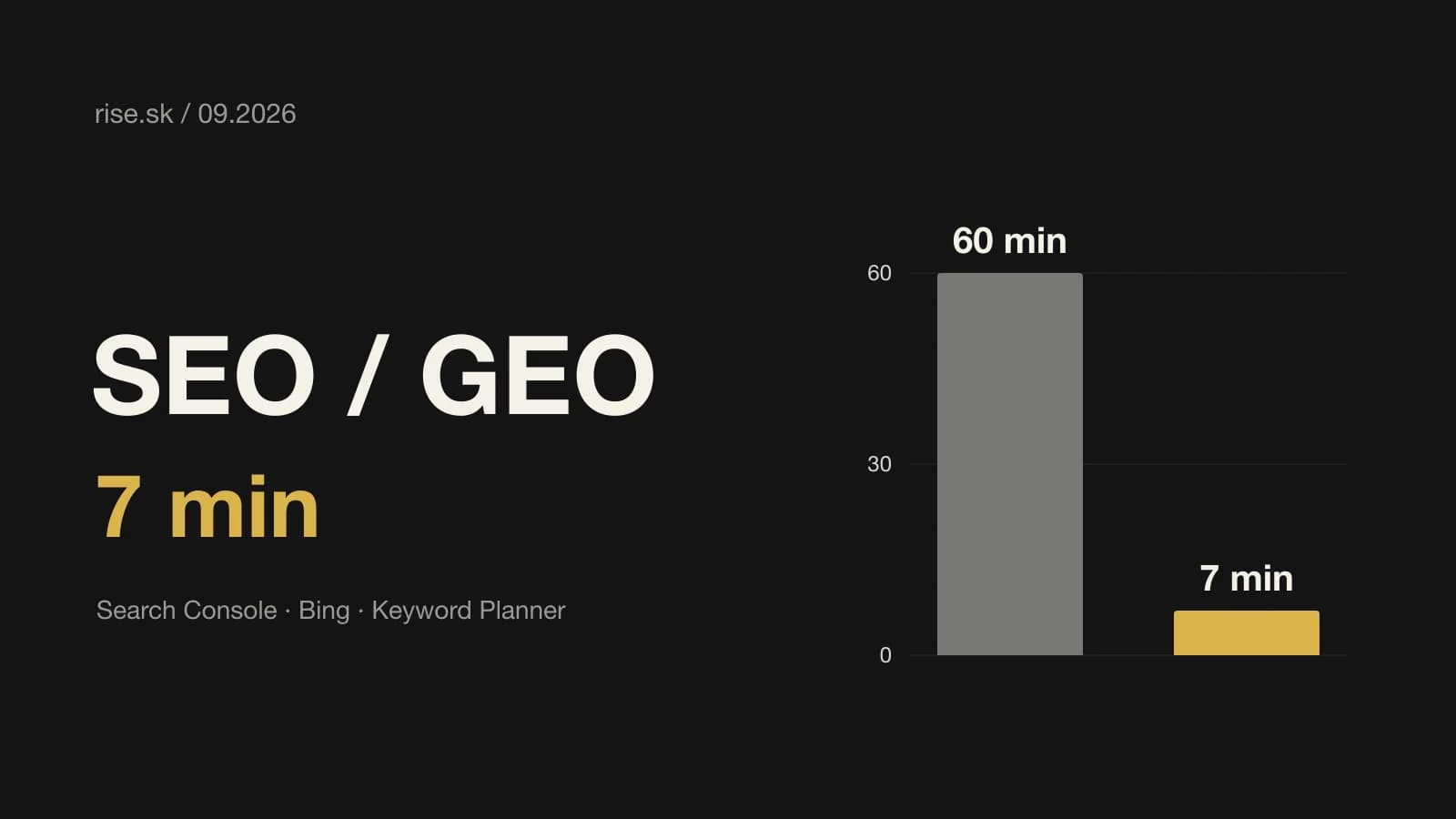
The bigger change at Rise.sk happened a few days earlier and had nothing to do with the new model. Checking how our site does in search used to take me about an hour a week in Search Console, Google Analytics 4, Bing Webmaster Tools and Microsoft Clarity. Claude built one overview from the free tools we already had. The weekly check now takes seven minutes.
Anthropic's pricing page lists Opus 5.5 at $4 per million input tokens and $20 per million output tokens, against $5 and $25 for Opus 5. Cache reads, which is what you pay when the model reads text it has already seen, fell from $0.50 to $0.20 per million.
On a smaller screen, scroll the table horizontally.
| Model | Input per 1M tokens | Output per 1M tokens | Cache read |
|---|---|---|---|
| Claude Opus 5 | $5 | $25 | $0.50 |
| Claude Opus 5.5 | $4 | $20 | $0.20 |
| Claude Sonnet 5 | $2 | $10 | $0.20 |
| Claude Haiku 4.5 | $1 | $5 | $0.10 |
For analysis the last column is the one that counts. A Search Console export and a crawl of the site stay in context for the whole session, and the model rereads them at every step, each time at the cache price.
Anthropic says the model works at the level of Claude Fable 5.1 on most tasks and costs 40% less to run than Opus 5, with output more than 30% faster. On Chartography, a chart-reading test, it scored 89.0% with tools against 83.4% for Opus 5. Those are the vendor's numbers, not ours.
We route work between models by a written rule, and anything that needs judgment goes to Opus. That covers analysis of data and documents, root-cause tracing, database migrations and anything touching security or a production deploy. Sonnet summarizes material or runs a documented command and reports back, and Haiku sweeps files for a string. When nobody is sure which side a task falls on, it counts as judgment.
For input and output, Sonnet 5 costs half as much as Opus 5.5 and Haiku 4.5 a quarter, so the rule pays for itself.
The second rule is about code. Wherever our code calls a model, it names the exact ID, such as claude-opus-5-5, never the shorthand “opus”. In tools like Claude Code that shorthand always points at the newest Opus, so an application relying on it would start behaving differently without anyone deciding or testing the change. Claude Code, where we work every day, uses it in its model picker and switched to Opus 5.5 by itself, while our own code stays put until someone changes the ID on purpose.
Changes to our website's code go first to a second agent that sees only the diff and the request, never the author's explanation, and only then to a person. The setup is described in our post on a review-gated agentic workflow.
The questions were commercial. We wanted to know which topics Google shows us for and where the people seeing us are. A third came later, about what an AI assistant says when someone asks it to recommend a Slovak software supplier.
Claude combined Search Console, Bing Webmaster Tools, Google Keyword Planner and a crawl of all 758 URLs in our sitemap, which it ran itself, and we paid for none of the three tools. We do the same for clients when we connect the tools and data they already have.
Between 17 June and 16 September 2026, Search Console counted 15,400 impressions across 619 pages. Of the 464 query rows Google publishes for that period, 47 had an average position in the top three and another 130 were on the first page.
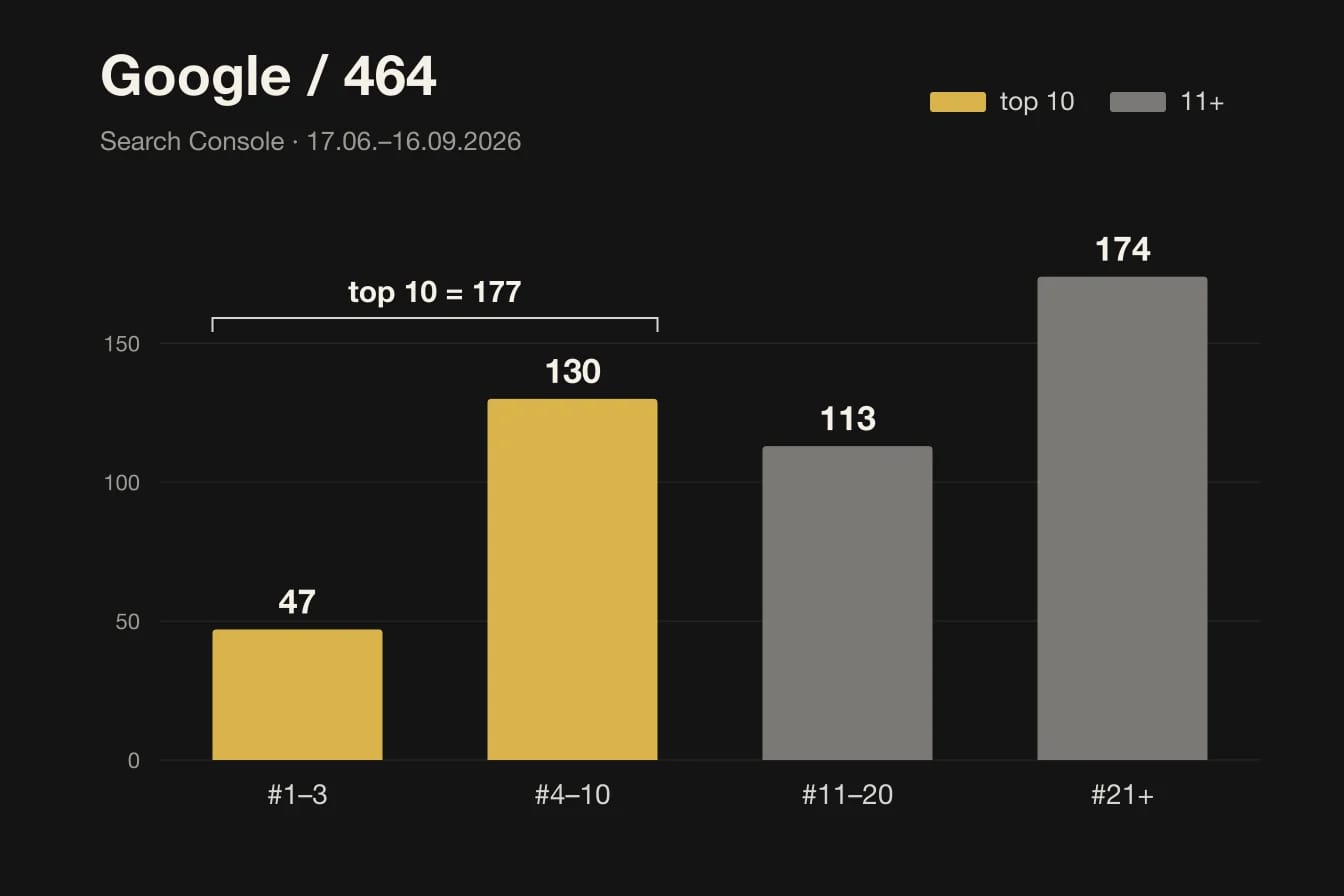
Gold is the first page of results. Our Search Console puts 177 of the 464 queries there for the three months to 16 September 2026, more than a third.
Our article on document management is the strongest page on the site with 2,075 impressions in the quarter, and the second most clicked is a piece on pay transparency, which is really about payroll and HR systems.
Slovakia gave us 6,830 impressions and Czechia 485, although Google Keyword Planner has “ERP systém” at 1,000 to 10,000 searches a month in Czechia against 100 to 1,000 in Slovakia. Slovak phrases such as “softvér na mieru”, custom software, get 10 to 100.
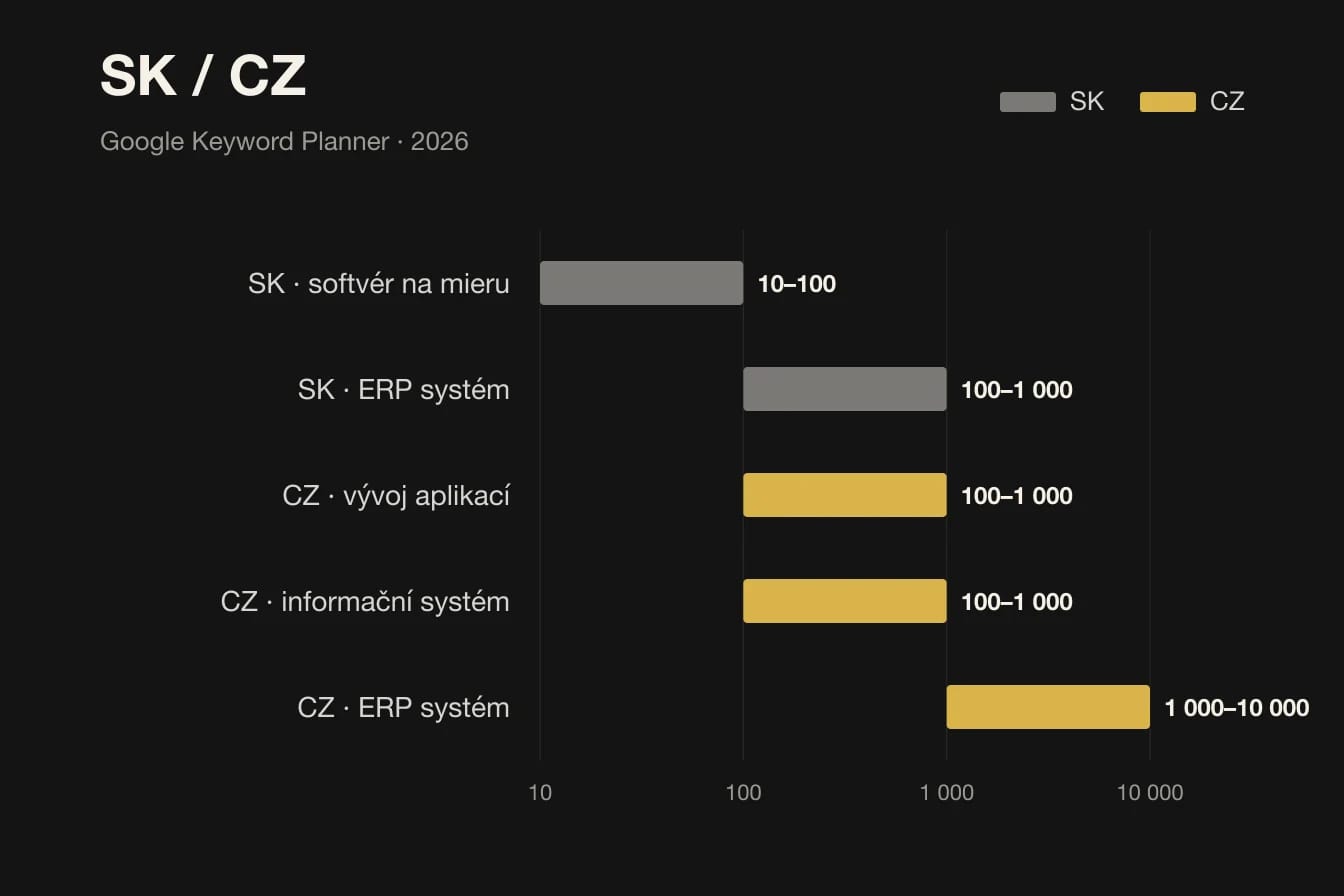
Grey is Slovakia and gold is Czechia, using Google Keyword Planner data from September 2026. ERP systém is searched roughly ten times as often in Czechia.
The practical lesson for a company selling in both countries is that Czech pages need the terms Czech buyers type, and a translation from Slovak tends to miss them. Our Czech development page had never once used “ERP systém” or “vývoj aplikací”, although the second gets 100 to 1,000 searches a month there and the first roughly ten times that. Its title now reads “Vývoj aplikací a informačních systémů na míru”.
We ran the third question by hand on 19 September in Google AI Mode set to Slovak, asking which Slovak company can take over and modernize an outdated internal system. It named Rise.sk first and got our method right, from the facade we put in front of an old system to the contract tests and the period when old and new run in parallel.
Asked about automating invoices and documents for a company of 100 people, it did not mention us. It named firms whose service pages carry exactly that title, even though our article on the subject is our strongest page.
We took a working rule from that, not a law. An AI assistant appears to take a supplier's name from a service page that names the offer with its scope and price, and to use articles only to phrase the answer. So document and invoice processing now has its own offer page, and so do payroll and HR systems. The modernization page added “software takeover” to its title, the phrase a buyer uses once the original vendor has gone.
We offer the same work to clients as AI visibility, and there is a longer guide on preparing a company website for AI Overviews and AI Mode.
The crawl also turned up something Search Console does not show directly. Of 758 page titles, 345 ran past 60 characters and the longest reached 125. Google shows a title only as wide as the result allows, so long ones often get cut and readers never see part of what they promise.
We rewrote 134 titles and descriptions in three languages, 52 of them in Czech. Article and main-page titles now stay within 60 characters and descriptions within 160. A length check in npm run check rejects any new article that breaks the limit, this one included.
We also dropped the German version of the site, and the Hungarian and Spanish ones with it, 155 pages whose translations were fine. Our buyer is a Slovak or Czech company with 20 to 250 employees, and those languages do not reach it.
Before the overview, the weekly check took me about an hour, and now it takes seven minutes. Over 52 weeks that is roughly 46 hours, more than a full working week.
At a glance I can see which keywords matter to us right now and what gets clicked most. Positions and impressions interest me least, because they show which topics Google takes us seriously on while other numbers bring in business.
The overview tracks seven numbers, each with a 90-day target. The two I care about most are clicks from searches that do not include our name and clicks to offer pages. The rest are clicks from Czechia, the number of sites linking to us, reviews on our Google Business Profile, citations in AI answers and whether AI mentions us across our fixed set of buying questions. Four have no API, so we enter them by hand with the date they were measured, and the overview marks any of them as stale once it passes its expiry date. The buying-question set is still waiting for its first measurement.
It cannot tell us which industry our visitors work in. Search Console and Google Analytics 4 do not record it, and our contact form does not ask. We can guess from what people search for, but a guess is not a measurement.
Recordings from Microsoft Clarity are not in the overview at all, and Google Analytics 4 counts only visitors who accepted analytics cookies. Reports following the path from a portfolio project to a sent form went live on 23 September, with the first results due for review at the end of October.
The overview answers in seven minutes the question that used to take me an hour. Choosing what to change next is still a decision for people, not for Claude.
We prepared this article with Claude Opus 5.5. The website figures come from Search Console and our audit of 19 September 2026, the prices and test results from Anthropic's own pages.

Founder and CEO of Rise.sk. He designs and delivers web applications, data systems, and automation, and writes about software decisions, AI, and digital services.
Google says the basics still matter for AI Overviews and AI Mode. The difference is that weak content and technical debt have less room to hide.

Everyone talks about AI agents. Most companies do not need one. Good automation is enough, and here is how to tell the difference.
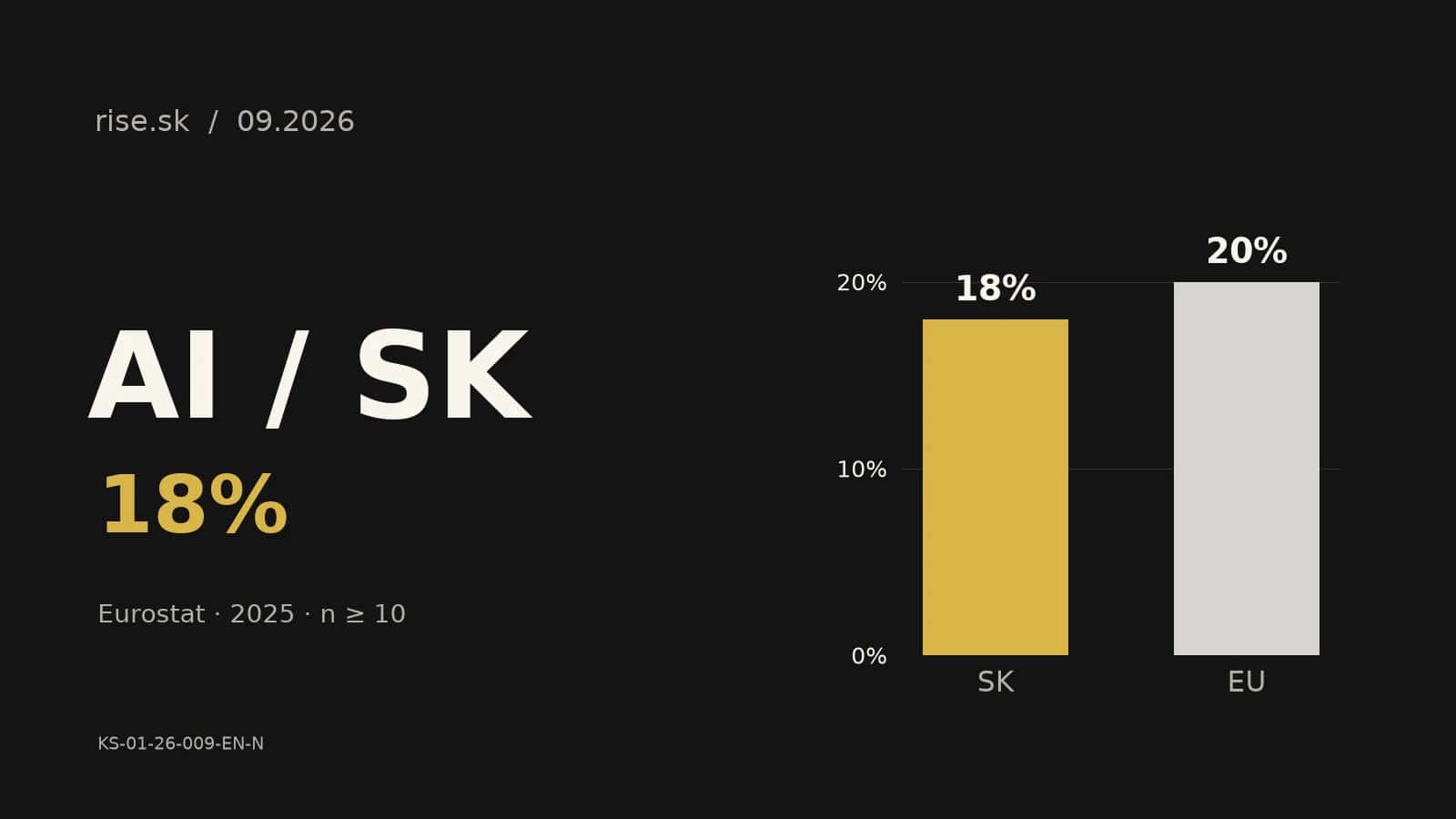
What September AI releases mean for Slovak businesses and municipalities. Eurostat data, practical scenarios and a modelled calculation of time released.